
2026.08.07

Innovative Lavastone Solutions for High Traffic Areas

Table of contents

Innovative Lavastone Solutions for High Traffic Areas

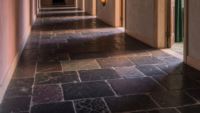
High traffic is a vague phrase that hides three separate demands: abrasion under constant footfall, grip on a surface that will be wet at some point every day, and the ability to survive whatever gets spilled on it. A material can answer one of those and fail another, which is why a decision about floor tiles and bar tiles is really a decision about which finish family goes where.

Lava stone handles this well, but the reasoning has to be done at the level of the finish rather than the material. Ranieri publishes ten surface families across four base materials, and they behave differently enough that two of them carry explicit warnings against exactly the situations a busy venue creates.

What follows is the documented set: which family is built for grip, how the thickness bands work as a wear budget, which finishes belong nowhere near a counter, and which figures a specification should request rather than assume.

The family built for grip, and what its name promises

One of the ten families is called non-slip. It is built on the Compact base material and finished with a coloured matte crystal over a coloured engobe ground, published in four colours: Terra, Havana, Concrete and Rattan. The matte crystal is the operative part; the engobe ground beneath it carries the colour, so the surface reads as a finished colour rather than as a treatment applied over something else.

The name describes the intent of the family and its position in the range. A slip resistance class is a different kind of statement, expressed as a tested value under a named standard, and that figure is established by finish and by format. A specification for a hotel lobby, a restaurant floor or a public circulation route should request it for the exact finish being proposed, together with the test method behind it.

This matters more in lava than in a pressed industrial product, because the ground under the finish is a mineral body with its own texture. The number that applies to one family on one format is the number for that combination, and reading it across the whole range would be a mistake.

Thickness as a wear budget: 10, 20 and 30 mm

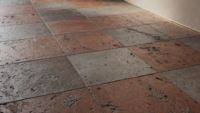
Flat formats are produced in three thicknesses: 10, 20 and 30 mm. This applies to both geometries in the range, squares at 50 x 50 and 100 x 100 mm and bars at 300 x 25 and 600 x 40 mm, so thickness can be chosen independently of the module.

For a busy interior the choice usually resolves into a build-up question. A 10 mm module lets lava go down over an existing floor where the finished level is already fixed, which is the common condition in a refurbishment inside an occupied building. Where the floor is being built from scratch and will take trolleys, luggage or service traffic, 20 and 30 mm give a substrate that behaves as a floor in its own right rather than as a facing.

Three-dimensional profiles sit in a different band, at 30 and 50 mm. The nine 3D bar profiles all share a 600 x 40 mm footprint and vary only in profile and height, which is useful on a vertical surface that takes contact: the bar fronts and reception faces that get kicked, scuffed and cleaned every day can mix profiles across one continuous grid.

The finishes to keep away from a busy counter

Two published warnings deserve to be read before a metallic finish is proposed for a working surface. For the Metallic Stone Gold finish, the documentation states that direct contact with acidic drinks or food should be avoided. For Metallic Stone Bronze, it states that tea, coffee and wine should not be placed directly on the surface, because staining can damage the finish irreparably.

Read against a hospitality brief, those two sentences settle the question. A bar top, a restaurant table and a service counter are defined by precisely the contact those warnings exclude, so the metallic family belongs on vertical surfaces, decorative panels and elements that are looked at rather than worked on. Gold is also the only third fire finish in the range, a gold luster over enamel, which is another reason to keep it away from abrasion.

The same reasoning applies to the pool declaration in reverse. Metallic stone and linear color are the only two families not declared for swimming pool use; the other eight are. In a spa, a wellness area or a pool surround, that leaves eight families to choose from and two to set aside, which is a far more useful starting point than a general claim about volcanic stone being durable.

A tolerance of 3 to 8 mm, and the details it rules out

Products with textural surfaces carry a published dimensional tolerance of 3 to 8 mm. In a high traffic context this is the single figure most likely to cause trouble on site, because it interacts with everything that has to be flush.

A tolerance of that size rules out details that depend on a zero-joint meeting between a tooled lava element and a machined material: a flush transition to a metal threshold, a continuous line between stone and a fitted counter edge, a coplanar junction with glass. The available answers are the ordinary ones, applied deliberately rather than discovered late: shadow gaps, recessed joints, deliberate reveals, and setting out that lets the variation fall where it can be seen as intentional.

The tolerance is a property of the tooling, so it belongs to textural surfaces specifically. Where a project genuinely needs a tighter dimensional result, the conversation should start from the smoother families rather than from an attempt to hold a textural surface to a tolerance it does not publish.

What to request before specifying

The published documentation is clear about material behaviour and explicit about dimensions. Quantified performance values are the part that has to come from the workshop, for the specific finish and format: slip resistance class and test method, abrasion resistance, water absorption, frost resistance where the surface runs outdoors, and chemical resistance where a cleaning regime is already fixed by the operator.

Contract environments usually have a maintenance protocol before they have a material, and it is worth putting that protocol in front of the workshop early. A finish that performs well under a neutral cleaner and poorly under an aggressive one is a finish that will be judged on the operator’s routine rather than on its specification.

Wear that reads as age rather than damage

There is a reason this material suits places that are used hard, and it has little to do with hardness alone. A surface made of pressed uniform units declares every scratch, because uniformity is the reference against which damage is measured. Lava starts from variation: craquelé in the glazed families, mineral difference between one piece and the next, the darker accumulation of hand-applied glaze on a stopped edge.

Against that ground, the marks left by use are absorbed rather than displayed. This is why Ranieri treats those variations as the grammar of the material instead of as a tolerance to be tightened. The volcano supplies the irregularity; the project decides how much of it to keep; and in a room crossed by several hundred people a day, keeping some of it is the more durable decision.

FAQ

Is lava stone suitable for commercial floors?

Ranieri documentation describes lava as harder and more resistant than marble, and publishes floor among the declared applications for the surface families. For a commercial specification, request the slip resistance class and abrasion figures for the exact finish and format, since those values are established per combination.

Which lava stone finish is intended for grip?

The non-slip family, built on the Compact base material with a coloured matte crystal over a coloured engobe ground, published in Terra, Havana, Concrete and Rattan. The family name states the intent; the tested slip resistance class should be requested for the specific finish and format being specified.

Which finishes should be avoided on bar and restaurant counters?

The metallic family. Published warnings state that Metallic Stone Gold should avoid direct contact with acidic food and drink, and that tea, coffee or wine placed directly on Metallic Stone Bronze can damage the finish irreparably. Both belong on surfaces that are looked at rather than used.

What thickness should be specified for a high traffic floor?

Flat formats come at 10, 20 and 30 mm. A 10 mm module suits refurbishment over an existing floor where the finished level is fixed; 20 and 30 mm suit new build-ups taking service traffic. Three-dimensional profiles sit separately, at 30 and 50 mm.

How is the 3 to 8 mm tolerance handled on site?

Textural surfaces publish a dimensional tolerance of 3 to 8 mm, so junction details should use shadow gaps, recessed joints and deliberate reveals rather than flush meetings with machined materials. Where a tighter result is essential, start from the smoother families instead of the textural ones.

Published figures for a high traffic specification

Specification variable

Published figure

Consequence in a busy environment

Flat format thickness

10, 20 and 30 mm

Choose 10 mm over an existing floor with a fixed level; 20 and 30 mm for new build-ups under service traffic

Three-dimensional profiles

30 and 50 mm; 3D bars all 600 x 40 mm in plan

Nine bar profiles share one footprint, so vertical surfaces that take contact can mix profiles on a single grid

Dimensional tolerance

3 to 8 mm on textural surfaces

Rules out flush junctions with machined materials; detail with shadow gaps and recessed joints instead

Grip

non-slip family, four colours, matte crystal on engobe ground

Family intended for grip; request the tested slip resistance class per finish and format

Metallic finishes

Gold: avoid acidic food and drink. Bronze: tea, coffee and wine can damage irreparably

Keep off counters and tables; suitable for vertical and decorative surfaces

Swimming pool and wet areas

Eight of ten families declared; linear color and metallic stone excluded

Eight families remain available for spa, wellness and pool surrounds

Quantified performance

Established per finish and format

Request slip class, abrasion, absorption, frost and chemical resistance for the exact specification