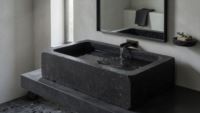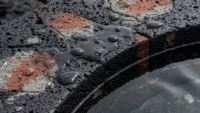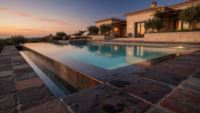
Two different materials travel under one name, and a design project pays for the confusion. Crushed volcanic aggregate supplied as filter media is graded rubble: porous, easy to handle in bulk, effective as a substrate for the bacterial colonies that do the actual biological work in a pond or a treatment bed. Architectural lava stone is a quarried and worked material that becomes a finished surface, specified by finish family, format and thickness.
Both come from a volcano. Beyond that they share very little, and a specification that treats them as one material will get the wrong answer to whichever question it was really asking.
The useful distinction is this. Filtration is a plant question, resolved with the pool or water treatment engineer and the media they specify. What a design project decides is everything the water touches afterwards: the tank, the surround, the coping, the steps, the basin. That second question is the one Ranieri publishes data for, and it is the one this article answers.
What the water actually asks of a surface
A surface in permanent or repeated contact with water is under three demands at once. It has to hold its finish against treated water, which in a pool means a chemical regime and in a fountain often means hard water and periodic drying. It has to stay walkable when wet. And it has to survive the thermal cycle of a surface that is submerged, exposed, heated by sun and cooled again.
Those demands are answered by the finish family, not by the material in general. This is the reason a specification that stops at volcanic stone is unfinished: within the same stone, some families are declared for water and some are not.