
2026.07.27

Lava Rock Filtration: Enhancing Water Quality in Design Projects

Table of contents

Lava Rock Filtration: Enhancing Water Quality in Design Projects

Lava stone is known above all for its use in architecture and design.

Floors, wall coverings, kitchen countertops, tables, basins and three-dimensional surfaces are its most visible face.

There is, however, a different field, tied to the porous structure of certain volcanic rocks: their use as a medium in biological and mechanical water filtration systems.

It is important to distinguish this application from stone destined for architectural surfaces.

Suitability for filtration is never automatic, and volcanic filter media cannot be used interchangeably. Grain size, composition, provenance, porosity and stability all have to be verified in relation to the system.

What matters, from a design standpoint, is observing how one and the same geological origin can offer very different possibilities.

Lava does not change its nature. It is the project that recognizes different properties in it, each time.

Although our experience is often expressed in the creation of distinctive lavastone kitchen countertops, resilient lavastone floor tiles and wall coverings, sculptural bathroom lavastone sinks and textured 3D lavastone tiles for the hospitality sector, the intrinsic properties of this material extend far beyond interior design applications.
The porous structure behind filtration

As magma cools, gases can generate cavities and porosity within the rock.

In some volcanic materials this structure produces a high specific surface area: a useful condition in biological filtration systems.

The cavities can offer support for colonization by the microorganisms involved in nitrogen transformation processes.

Nitrifying bacteria, in particular, contribute to the conversion of ammonia into nitrites and subsequently into nitrates. This process is an important component of the biological balance of ponds, aquariums and controlled aquatic systems.

The rock does not purify water on its own.

It works as a medium within a properly designed system.

The relationship between stone and water

The irregular structure of a volcanic material can operate on two levels.

The first is mechanical: the spaces between the elements and the roughness of the surface can help retain part of the suspended material.

The second is biological: the available surface allows the development of microbial colonies that take part in the transformation of organic substances.

Effectiveness depends on flow rate, oxygenation, material size, contact time and maintenance.

Water has to pass through the system in a controlled way.

Quality depends not only on the choice of the stone, but on the way the entire path is designed.

Applications in landscape architecture

In landscape projects water is no longer considered exclusively as a decorative element.

Bio-lakes, natural pools, ponds, channels and water gardens call for systems capable of maintaining a balance between visual quality, biological function and maintenance.

Suitably selected volcanic materials can be placed in filter beds, submerged zones, gabions or layered systems.

In some cases the system is concealed. In others it becomes a visible part of the landscape architecture.

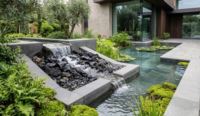
A rock wall crossed by water, a constructed wetland or a filtering terrace can perform a technical and a spatial function at the same time.

Technology does not necessarily have to disappear.

It can be made legible and become part of the project.

Mechanism

Property used

Possible function

Mechanical filtration

Irregular structure and interstices between the elements

Retention of part of the suspended particulate

Biological filtration

Surface available for microbial colonization

Support for nitrification processes

Landscape integration

Mineral origin and material presence

Integration of the system into the design of ponds, channels and bio-lakes

Attributing a genuine, universal chemical action to the rock would be inappropriate. Its behavior depends on the composition of the material and has to be verified before use.

Passive systems and design

Contemporary research looks with interest at systems that reduce energy consumption and the use of chemical treatments.

Biological filtration can contribute to this objective, though it is a process with technical requirements of its own.

The filtering volume has to be correctly sized, the speed at which the water passes through has to be established, adequate oxygenation has to be guaranteed and maintenance operations have to be planned.

Grain size plays a central role.

Larger elements favor the passage of water and intercept coarser debris. Finer grain sizes increase the available surface, but can clog more easily.

The solution therefore arises from a balance between flow, biological surface and ease of cleaning.

The material alone does not resolve the project.

It is the project that puts the material in a position to work.

Balance of the aquatic ecosystem

In natural pools, ornamental ponds and koi ponds, water quality has a direct impact on the health of the ecosystem.

A correctly sized biological system contributes to the transformation of nitrogen compounds and can limit conditions favorable to the uncontrolled proliferation of algae.

Water clarity, however, does not depend on a single element.

Light, temperature, the presence of plants, organic load, circulation, oxygenation and maintenance all take part in the same balance.

Volcanic stone can be a component of the system, rather than an isolated solution.

This distinction is essential from a design point of view as well.

Understanding a material means recognizing both its potential and its limits.

Conclusion

The use of volcanic materials in filtration systems shows how one and the same geological origin can take on different roles.

In architecture, the stone becomes surface, volume and color.

In the landscape it can become the medium for a biological process and a visible part of the water's path.

In both cases the principle remains the same: quality arises from a precise understanding of a material's behavior, rather than from its generic application.

Before transforming matter, one has to learn to listen to it.

FAQ

Is lava stone suitable for water filtration?

Some porous volcanic materials can be used as a medium in biological and mechanical filtration. Suitability has to be verified on the basis of composition, grain size, stability, provenance and intended use.

What effects does it have on water?

It can help retain particulate matter and offer a surface for the colonization of beneficial bacteria. It does not, however, purify water on its own and has to be placed within a correctly sized system.

Can it be used as a filter medium?

Yes, in applications such as ponds, bio-lakes, aquariums and landscape systems, provided it is selected and used according to appropriate technical criteria.

How does it support biological filtration?

The porous structure offers a surface on which the microorganisms involved in the transformation of nitrogen compounds can develop. The process requires oxygenated water, adequate flow and correct maintenance.