
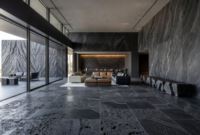
2026.07.27

Lava Rock in High-End Architecture: A Global Trend

Table of contents

Lava Rock in High-End Architecture: A Global Trend

Contemporary architecture is returning to question its materials.

After decades dominated by uniform surfaces, perfectly replicable and free of variation, interest is growing in matter capable of preserving a recognizable origin and of taking part in building the identity of a place.

Lava stone belongs to this category.

It is born of a geological process that is violent and extremely slow at once. It is the result of fire, pressure and cooling. In the project, this origin does not disappear: it remains legible in the structure, in the texture and in the variations of the surface.

Lava stone is born of fire. It finds its form in the project.

Ranieri works this matter to produce architectural surfaces, natural and glazed tiles, kitchen countertops, tables, basins and three-dimensional elements developed to measure.

We do not start from a range of solutions to be applied indiscriminately. Every project calls for a different relationship between form, thickness, color, finish, light and use.

Our work consists in understanding how far matter can follow architecture without losing its own nature.

Ranieri Lavastone offers natural and glazed lavastone tiles and bespoke furnishings, including refined lavastone tables, for sophisticated interior and exterior applications. Our experience spans architectural surfaces, high-performance kitchen countertops and lava stone sinks developed as specific answers to complex design requirements.
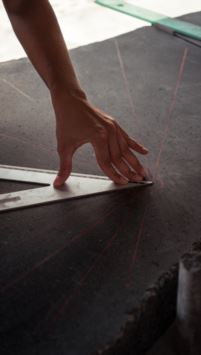
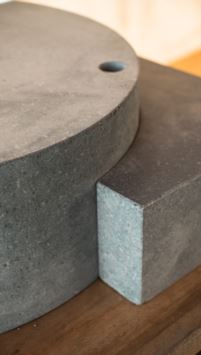
The return of lava stone in contemporary architecture

In recent years the way architects look at materials has changed.

Innovation no longer coincides with industrial perfection alone. More and more often it concerns the ability to integrate technical precision, memory, variation and depth.

Lava stone responds to this search because it holds together apparently opposite characteristics: it is solid yet workable, primitive yet suited to advanced processes, irregular in its own structure and precise in its transformation.

For a long time its use remained tied to volcanic territories. Today it enters international projects, private residences, cultural spaces, hotels, restaurants and artistic installations.

This is more than the return of a natural stone. It is the recognition of a material capable of conversing with the language of contemporary architecture.

Its expressiveness arises from the relationship between the basaltic core and the surface. In its natural state it retains a deep, porous, mineral character. Through glazing it can instead take on color, luminosity and variations that are difficult to obtain with other bodies.

The surface does not conceal the stone. It interprets it.

Properties and architectural applications

The characteristics of lava stone allow very different applications to be developed, provided the material, the finish and the laying system are assessed in relation to the project.

Characteristic

Architectural relevance

Applications

Stability under thermal variation

Allows use in contexts subject to changes in temperature

Exterior surfaces, elements near heat sources, worktops

Porous structure

Favors the relationship with high-temperature ceramic glazes

Chromatic research, bespoke finishes, glazed surfaces

Compressive strength

Allows use in architectural applications subject to stress

Floors, wall coverings, monolithic elements and high-traffic spaces

Basaltic composition

Offers good performance in interior and exterior environments when correctly specified

Facades, exposed surfaces, architectural details and furnishings

Integrating lava stone into a building means choosing a surface that is not simply added to the architecture, but that takes part in the rhythm of the space.

This emerges with particular clarity in hospitality projects and in private residences, where the tactile quality, the light and the variation of the surfaces contribute directly to the experience of the place.

Lava stone in the history of cities

Long before entering contemporary projects, lava stone had already built entire cities.

In volcanic territories it was used for centuries in pavings, facades, stairways, churches, streets and public spaces. Its strength depended not only on resistance, but on the direct bond with the landscape and with the material culture of the place.

The dark cathedrals of Clermont-Ferrand and the architecture of Catania show how volcanic stone can define the image of an entire city.

Between the late nineteenth and early twentieth centuries, glazed lava also entered Parisian architecture and urban graphics, through plaques, signs and decorations capable of uniting color and durability.

Contemporary projects take up this legacy and move it onto new scales.

The stone can become a large facade panel, a continuous surface, a three-dimensional element, a table or a detail measured in a few centimeters.

The dimension changes. The strength of its origin does not.

Cultural interpretations of volcanic stone

Every culture attributes different meanings to volcanic stone.

In the Mediterranean it is bound to transformation, to resilience and to the capacity of the landscape to regenerate after destruction.

In Japan, variation, discontinuity and the marks of the process can converse with a sensibility close to wabi-sabi, where imperfection is a quality to be observed rather than a flaw to be erased.

In Mexico, basalt recalls an ancient building tradition, reinterpreted by numerous architects through essential geometries and contemporary languages.

In European design, by contrast, interest often concentrates on the relationship between mineral body, glaze and firing: a line of research in which color is not simply applied, but arises from a physical and chemical transformation.

What these readings have in common is the refusal of absolute uniformity.

Lava stone does not produce completely identical surfaces. It retains variations, tensions, differences in tone and marks of the process.

For Ranieri this characteristic is not to be corrected. It is to be understood, controlled and turned into a conscious part of the project.

The future of lava stone in global design

The future of lava stone arises from the meeting of craft knowledge, research and technology.

Numerically controlled machining makes it possible to obtain complex geometries and precise profiles. Three-dimensional modeling allows deep surfaces and unconventional rhythms to be developed. Experimentation with glazes widens the relationship between color, light and mineral structure.

Technology, however, does not replace knowledge of the matter.

Every process has to come to terms with density, porosity, thicknesses, firing tensions and natural variations. It is in this confrontation that the project takes on value.

The environmental question calls for precision as well.

Lava stone is a natural and durable material. Its actual sustainability depends, however, on origin, extraction processes, transformation, logistics, the lifespan of the application and the possibility of preserving it over time.

Longevity remains one of its principal values: designing surfaces meant to last means reducing the logic of continuous replacement.

Lava stone and design culture

The growing interest of the international architecture community depends on more than the visual impact of lava.

It depends on its ability to build a coherent language across different scales and functions.

Within a single project, lava stone can become floor, wall covering, worktop, table, basin or sculptural element. Every application keeps a common origin, while responding to different technical requirements.

It is here that matter becomes design culture.

Rather than a spectacular surface applied at the end, a presence developed together with the architecture, through prototypes, samples, color tests and technical verifications.

Conclusion

For Ranieri lava stone is more than the material we work with.

It is the point from which we observe the project.

Every surface is born before production: in the exchange with the architect, in the understanding of the space, in the relationship with light and in the definition of the way it will be lived.

Our task is not to make lava perfectly uniform.

It is to understand its behavior and accompany its transformation.

Nature creates the stone.

The project gives it a form, a function and a new possibility of existing.

FAQ

What does lava stone symbolize?

Lava stone is often associated with strength, transformation and permanence. Its volcanic origin establishes a direct relationship with geological time and with the energy of nature. In a project it can express rootedness, material depth and continuity.

Is lava stone a good building material?

It can be used in numerous architectural applications thanks to its compressive strength, thermal stability and durability. The correct intended use depends, however, on the type of stone, the finish, the thickness, the laying system and the environmental conditions.

Is lava stone sustainable?

It is a natural and durable matter. Assessing its sustainability requires considering the entire life cycle: extraction, transformation, energy used, transport, laying, maintenance and lifespan. The possibility of producing elements meant to endure is one of its principal advantages.

How can it be used in landscape projects?

It can be used for pavings, paths, exterior surfaces, edges, walls, seating and elements in relation with water and with the landscape. Finish, roughness and laying system have to be defined according to climate, safety and intended use.