
2026.07.27

Why lava stone is entering high-end residential projects

Table of contents

Why lava stone is entering high-end residential projects

A house tells far more than the taste of the person who lives in it.

It tells the way one chooses to inhabit time, light, spaces and materials.

For this reason, in contemporary residential architecture, matter is no longer considered only in terms of resistance or prestige. It becomes part of a language capable of accompanying daily life and of building continuity between rooms.

Ranieri works alongside architects and designers in the development of bespoke surfaces and elements in natural and glazed lava stone.

Kitchen countertops, floors, wall coverings, basins, tables and three-dimensional elements are conceived not as isolated products, but as parts of one and the same architectural vision.

A single stone can take on very different functions, scales and characters.

The project establishes which ones.

Our material experimentation leads to the creation of highly specialized elements, ranging from meticulously engineered lavastone floor tiles to exclusive furnishing solutions.

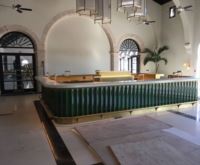
Through continuous collaboration with visionary professionals, we also develop unique pieces such as sculptural bathroom lavastone sinks, refined lavastone tables and highly tactile 3D lavastone tiles, intended for bar counters and feature walls within projects of considerable complexity.
The versatility of lava stone in residential architecture

Contemporary homes ask for continuity.

The kitchen converses with the living area, interior spaces open towards the garden, terraces become outdoor rooms and large glazed openings reduce the distance between house and landscape.

Within this system of relationships, lava stone can work as a connecting element.

In its natural state it presents a porous texture, deep tones and mineral variations. Glazed, it acquires color, reflections and a more compact surface, while keeping the nature of the body legible.

This twofold possibility makes it possible to work through continuity or through contrast.

An exterior paving can converse with an interior kitchen countertop. A monolithic island can share the same geological origin as a basin or an engraved panel. A three-dimensional wall can introduce depth without adding a material extraneous to the project.

The stone is not superimposed on the space.

It is developed as a part of it.

Performance in residential environments

A residence brings together very different conditions.

The kitchen calls for surfaces suited to heat, water and daily use. The bathroom has to live with humidity and detergents. A terrace faces solar exposure, rain and temperature variations. Pool edges have to respond to requirements of safety, roughness and durability.

Lava stone can be adapted to these conditions through the choice of finish and processing.

The basaltic body offers resistance and mass. Glazing adds a vitrified surface, chromatically controlled and easier to manage in specific contexts of use.

The craquelure characteristic of many glazed surfaces is not an applied decoration. It is the result of the differing tensions between stone and glaze during cooling.

It is a trace of the process.

State of the material

Properties

Aesthetic character

Possible applications

Natural lava stone

Compressive strength, thermal mass and good stability

Matt, porous surface, with tones from grey to anthracite

Floors, exterior surfaces, monolithic elements and landscape details

Glazed lava stone

Vitrified, colored surface with reduced absorption

Gloss, satin or textured finishes, with possible variations and craquelure

Kitchen countertops, wall coverings, bathrooms, tables, basins and bespoke elements

Actual performance always depends on the correct design of the component, on the formulation of the glaze, on the laying and on the conditions of use.

Why practices choose lava stone

Every architect looks for materials capable of giving a project identity without taking the place of the architecture.

Lava stone has a strong presence, yet it can be calibrated.

It converses with wood, bronze, glass, concrete, steel and plaster. It can work through contrast or become part of a very quiet material palette.

What interests designers most is the possibility of intervening.

Dimensions, thicknesses, edges, radii, textures, glazes and processes can all be developed in relation to the design. The process goes through tests, samples and prototypes, because every surface has to find its own balance between idea and physical behavior.

Lava stone makes no promise of absolute identity between one element and the next.

What it offers instead is coherence within variation.

This is a substantial difference with respect to industrial surfaces conceived to be perfectly replicated.

Provenance and material culture

In recent years the idea of residential luxury has changed as well.

Exclusivity no longer necessarily coincides with ostentation. It is increasingly tied to provenance, to the quality of the process, to the rarity of the skills involved and to the ability to produce elements that could not belong indifferently to any house.

Lava stone carries with it a precise geographical and geological origin.

Using it means introducing into the project a matter that already has a history before being worked.

The value lies not only in the stone, but in the way it is read, selected and transformed. A bespoke installation tells of the time devoted to development, of technical knowledge and of the dialogue between those who design and those who produce.

It is this process that makes a surface genuinely specific to a residence.

Continuity between interior and exterior

One of the central themes of contemporary residential architecture is the dissolution of the boundary between inside and outside.

Repeating the same color is not enough to obtain a credible transition. A deeper continuity has to be built between texture, format, rhythm of the joints and behavior of the surface.

Lava stone makes it possible to work on the same material origin through different finishes.

Outdoors it can be used with a more textured surface, suited to safety requirements. Indoors it can be honed or glazed, introducing a different relationship with light.

The two surfaces are not necessarily identical.

They belong, however, to the same language.

A floor can ideally cross a glazed opening and continue onto a terrace. An outdoor countertop can echo the material used in the interior kitchen. An architectural volume can change finish without losing continuity.

The quality of the project arises precisely from this ability to differentiate without fragmenting.

FAQ

What characteristics should a stone have for outdoor use?

It has to be assessed in relation to climate, intended use, safety, the laying system and maintenance. Mechanical resistance, frost behavior, absorption, roughness and color stability are some of the parameters to consider.

What is an exterior stone cladding?

It is a system in which stone elements are applied or anchored to the envelope of the building. It may be an adhered cladding, a mechanically fixed one or one integrated into a ventilated facade. The system has to be designed according to dimensions, weight, substrate and environmental conditions.

Which stones are used in contemporary residential architecture?

Basalt, travertine, marble, granite, slate and lava stone are chosen on the basis of performance and of the language of the project. They can be used for floors, wall coverings, worktops, basins, staircases and bespoke elements.