
2026.08.03

Design Without Borders: When Geology Meets Creativity

Table of contents

Design Without Borders When Geology Meets Creativity

Most materials used in architecture arrive with their variables already removed. They are manufactured to a tolerance, batched to a colour and delivered as a known quantity, and the design conversation begins after that standardisation is complete. Volcanic stone reverses the sequence: the geology comes first and sets the parameters, and the creative work happens inside them. That relationship, visible across the pages on lava stone as a material, is what makes lava a genuinely different proposition at the drawing board.

This is easy to describe romantically and harder to describe usefully. So it is worth being concrete about which geological variables actually reach the designer, what each one permits, and how the constraint turns into a decision rather than a limitation.

Four of them do most of the work: the base material, the void structure, the colour archive, and the block.

Four Materials, Four Behaviours

Lava is not one substance. The Ranieri surface documentation names four base materials, and the distinction is geological rather than commercial: Compact, Texture, Lunar and Pumice. Each has a different internal structure, and each therefore accepts different treatment.

Compact is the dense variant, and it carries the widest range of finishes: bare stone, tinted stone, surface definitions, citrus zest, non-slip, deep color and metallic stone all sit on it. A closed structure is what allows full-coverage colour to behave predictably. Texture is worked material, ridged and fissured, and it underpins the two families where colour is meant to gather in the relief. Lunar is the cratered variant, full of irregular voids, and only one family is built on it. Pumice, light and open-celled, appears once, as Dark Moon in the bare stone family.

The design consequence is direct. Selecting a finish means selecting a geology, and the two decisions cannot be separated. A designer asking for the movement of meteorite in a compact, closed surface is asking for two incompatible things, because the craters that produce that movement are the material.
When Voids Become Composition

In most stone specification, voids are the problem. Fissures are filled, holes are resined, and the objective is a continuous face. On lava the void is a compositional element, and three families treat it three different ways.

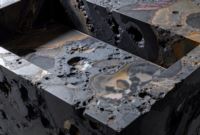
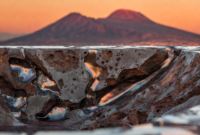
Meteorite makes voids the subject. Glaze insinuates itself into the natural craters and outlines them, some deep enough to read as caves, others revealing the grey stone underneath. Fired twice over a white foundation, the pits develop different effects again. The surface is described as never repeating, which is a statement about the geology rather than about the glazing.

Linear color works with tooled striations instead, so colour accumulates in the gorges and thins across the ridges. Where the material provides no relief, the workshop makes it. Textural surfaces take the opposite route: tooling camouflages the natural fissures rather than exploiting them, producing a raw volcanic reading without exposed voids.

Three answers to one geological fact. The variable is fixed; what changes is the intention brought to it.

Repeating the Unrepeatable: The Colour Archive

The obvious objection to a material of this kind is continuity. If every piece is different, how does a designer specify a second phase three years later, or match a refurbishment to an existing scheme.

The answer at Terzigno is archival. A bespoke colour is developed outward from a base theme colour into a palette of natural gradients, and once developed it is retained in the colour library so it can be brought back for a later project. Alongside it sits a standing archive organised by chromatic family, running from Whites and Neutrals through Yellows and Browns, Reds and Oranges, Pinks and Violets, Greens, Blues, and Greys and Blacks.

What this reproduces is the colour, not the piece. The lava carrying it will still vary block to block, because that variation is upstream of the process. In practice this is the right division: the specifiable element is held stable, and the geological element is allowed to remain what it is.

The Block as a Design Parameter

The fourth variable is the most quietly decisive. Blocks are cut at sizes up to three metres, and that number determines the boundary between what can be made in one piece and what must be assembled.

The Prima bathtubs make the boundary visible. Massa, at 1,700 x 700 x 530 mm, is carved from a single block. Tratto, at 1,760 x 660 x 495 mm, is composed from thin lava slabs joined together to create lightness and repetition. Almost the same envelope, resolved by opposite means, and the choice between them is a design position rather than a technical default.

The same parameter shapes the object collections. Core, designed by Francesco Meda and David Lopez Quincoces, uses deliberately archetypal forms, spike, round, line and frame, at sizes from 587 x 329 mm up to 1,400 x 600 mm, precisely so that the material rather than the silhouette holds attention. Void, designed by Mario Milana, reduces further to two elements, Mono at 400 x 400 mm and Lungo at 800 x 400 mm. Roots runs five surface gestures, smooth, vertical reeded, horizontal reeded, horizontal combed and flared, across three diameters from 600 to 900 mm, all in a single bare lava dark finish. Simple geometry, the whole variation carried by the stone.

Working the Volcano Rather Than Around It

Every design decision described above shares a structure: a geological condition is identified, and then a form is drawn that requires it. That is a specific way of working, and it is the opposite of the standard industrial approach, in which variation is progressively engineered out until the material becomes predictable enough to specify like a product.

The choice is visible in the history. Lava was conventionally used raw or completely obscured beneath heavy enamel, two options that share an assumption: the mineral face is something to be either accepted or hidden. The thin glazes developed at Ranieri were formulated to be read through, which required accepting that what shows through will differ every time.

This is what a family quarry at the foot of Vesuvius makes possible. The material is not selected from a range and ordered to a specification; it comes out of a specific mountain with a specific mineral history, and the work consists of finding what that particular stone will do. Design without borders, in this reading, means something quite precise: the borders are geological, they are non-negotiable, and the creative territory opens up once a designer stops trying to move them.

FAQ

Are there different types of lava stone?

Yes. Ranieri documentation names four base materials: Compact, dense and closed; Texture, tooled and fissured; Lunar, cratered and porous; and Pumice, light and open-celled. Each accepts different treatment, so choosing a finish also means choosing a geology. Compact carries the widest range of finishes.

Why is every lava stone surface different?

Because the variation is geological and sits upstream of the process. Mineral flecks, craters, fissures and density all differ block to block. Rather than suppressing this, the finishes are built to show it: meteorite outlines its natural craters with glaze, and the surface is described as never repeating.

Can a lava stone colour be repeated on a later project?

Yes. A bespoke colour is developed from a base theme colour into a palette of natural gradients and then retained in the Ranieri colour library, so it can be specified again years later. The colour is reproducible; the stone carrying it will still vary from block to block.

How large can a lava stone piece be made in one block?

Blocks are cut at sizes up to three metres, which sets the limit for monolithic work. The Prima bathtub Massa, at 1,700 x 700 x 530 mm, is carved from a single block, while Tratto is composed instead from thin joined slabs at a nearly identical overall size.

Who designs the Ranieri collections?

Francesco Meda and David Lopez Quincoces designed the Odissea, Core and Prima collections, and developed the deep color palette. Mario Milana designed the Void tables. The collections use deliberately simple, archetypal geometry so that the variation is carried by the material rather than by the form.

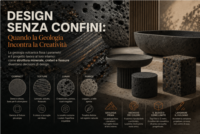
The four base materials and what they offer design

Base material

Geological character

Families built on it

Design consequence

Compact

Dense, closed structure

bare stone, tinted stone, surface definitions, citrus zest, non-slip, deep color, metallic stone

Widest finish range; the base for full colour

Texture

Tooled, ridged, fissured

linear color, textural surfaces

Colour pools in relief; strong haptic

Lunar

Cratered, porous, irregular voids

meteorite

Glaze outlines craters; never repeats

Pumice

Light, open-celled

bare stone (Dark Moon)

Distinct tonality within the bare register