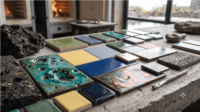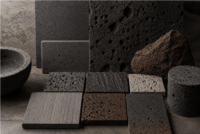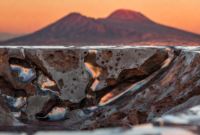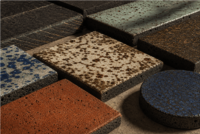
Glaze on lava stone behaves unlike glaze on any other architectural material, and the reason is thermal. Volcanic rock is born in fire, which means it tolerates the kiln temperatures that colour development demands, where marble and most natural stone would fail.
That single physical fact is what allows the Vietri ceramic tradition to be applied to a structural stone, and it is the foundation of every one of the glazed lava stone surfaces in the Ranieri collection.
For an architect writing a specification, the interesting question is rarely which colour. It is how that colour was put onto the stone: whether it sits on a ground layer or directly on the mineral face, how many firings it went through, and what that sequence means for the surface once the building is occupied. Firing method and ground layer determine appearance, depth, tactility and the environments a finish is declared for.
This article sets out the three variables that govern a glazed lava surface: the engobe ground, the number and type of firings, and the way a technique is matched to a base material. Every technical statement below is drawn from the Ranieri collection documentation.
The Engobe Ground: A Second Skin Before Colour
Engobe is a slip layer applied to the stone before the colour coat. Its role is to create a controlled, uniform ground so that the glaze above develops predictably rather than reacting directly with a heterogeneous mineral face. On lava this matters more than on ceramic, because the substrate is never uniform to begin with: mineral flecks, micro-fissures and density changes vary across a single slab.
Three families are built on a coloured engobe ground. Citrus zest uses a colored crystal over coloured engobe, producing full-bodied, undulating colour where the geology still reads through the movement of the enamel. Non-slip uses a matte version of the same construction, a colored matte crystal on coloured engobe, which is what generates its muted pastel range and its added haptic grip. In the metallic family, Titanium alone sits on an engobe ground, while Black Platinum and Bronze are applied as metallic enamel directly onto natural lava.
The practical consequence is that engobe-based finishes are the most chromatically consistent of the range. Where a project needs colour that repeats reliably across a large surface, the engobe families are the ones to look at first. Where the brief calls for the stone to remain legible under the colour, the direct-on-stone constructions serve better.