
2026.08.03

Technical Lava Solutions: Thickness, Resistance, Engineering

Table of contents

Technical Lava Solutions Thickness, Resistance, Engineering

A material becomes specifiable at the moment its dimensions stop being adjectives.

Volcanic stone is often described to architects in the language of character and origin, which is accurate but unusable at detail stage: an architect resolving a threshold, a substrate build-up or a cantilevered basin needs millimetres.

The technical parameters set out below sit behind the lava stone surfaces in the collection and govern how lava behaves as a construction element rather than as an image.

Three numbers do most of the work in a lava stone specification: the thickness range of the flat formats, the size of block available for monolithic pieces, and the dimensional tolerance of tooled surfaces. Each carries a design consequence, and each is published rather than estimated.

What follows is the documented set, together with an explicit statement of where the published data stops. That boundary is as useful to a specifier as the figures themselves.

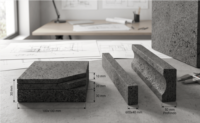
Thickness: 10, 20 and 30 mm Across the Flat Formats

The flat formats are produced in three thicknesses: 10, 20 and 30 mm. This applies across both the square and the bar geometries. Squares are made at 50 x 50 mm and 100 x 100 mm, each available in all three thicknesses. Bars are made at 300 x 25 mm and 600 x 40 mm, again across all three.

This has a direct consequence for build-up. A 10 mm module allows lava to be introduced as a cladding layer where the substrate depth is constrained, for instance over an existing floor or against a lightweight partition. A 30 mm module reads as a solid stone element and behaves accordingly in terms of weight and edge profile. The same colour and finish can therefore be carried across conditions of very different depth, which is what makes continuity possible between a floor field and a vertical return.

An older figure of three to four centimetres circulated in earlier material about lava thicknesses. The published range is 10 to 30 mm for flat formats and 30 to 50 mm for three-dimensional profiles, and specifications should work from those numbers.
Three-Dimensional Profiles and the 30 to 50 mm Range

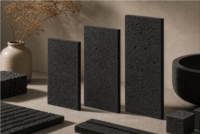
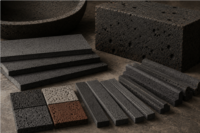
Three-dimensional formats occupy a different band. The 3D bar profiles, nine of them, are all 600 x 40 mm in plan and are produced at either 30 or 50 mm in height, depending on the profile. The 3D flat profiles are 300 x 300 mm or 300 x 150 mm, all at 30 mm. The Onda tile is 800 x 150 mm at 30 mm.

Because the nine bar profiles share an identical footprint and differ only in profile and height, they can be combined within a single field. Alternating 30 and 50 mm profiles across a wall produces relief without any change to the setting-out grid, which keeps the substrate and the joint pattern simple while the surface itself becomes sculptural. For a bar front or a reception face, this is the difference between a modelled surface and a modelled construction.

All of these profiles are available across the full finish range, from bare stone through to deep color, so the decision about relief and the decision about colour can be taken independently.

Monolithic Work and the Three-Metre Block

Blocks can be cut at sizes up to three metres. This is the figure that determines what is possible in one piece rather than in assembly, and it governs a whole category of work: washbasins and bathtubs carved from a single block, along with bar counters, kitchen counters and islands.

The Prima bathtubs illustrate both approaches within one collection. Massa, at 1,700 x 700 x 530 mm, is carved from a single block of stone. Tratto, at 1,760 x 660 x 495 mm, is composed instead from thin lava slabs joined together, which produces a lighter, repeating, graphic reading of the same volume. Two bathtubs of almost identical envelope, resolved by opposite means.

The washbasin range shows the same logic applied to smaller pieces. Terra, Linea and Alto are column basins at 900 mm high, standing from the floor as monoliths. Linea and Alto share identical dimensions at 380 x 380 x 900 mm and are distinguished only by the direction of their incisions, horizontal in one case and vertical in the other. The compact basins run from 140 mm high, in the case of Tono and Chiaro, up to 290 mm for Fluido.

Tolerance: Designing With 3 to 8 mm

Products with textural surfaces carry a published dimensional tolerance of 3 to 8 mm. For an architect this is the single most consequential number in the set, because it dictates junction strategy.

A tolerance of that magnitude rules out details that depend on a flush, zero-joint meeting between a tooled lava element and a machined component such as a metal frame, a glass edge or a cabinetry carcass. It equally rules out setting-out that assumes cumulative dimensional accuracy across a long run. What it supports is the shadow gap, the expressed joint, the recessed reveal and the scribed junction, all of which absorb variation and, in most cases, read better against a volcanic surface than a tight abutment would.

The tolerance is a property of the tooling, so it applies to textural surfaces specifically. Where a project genuinely requires tighter dimensional control, the smooth and polished finishes and the flat formats are the appropriate starting point, and the achievable tolerance should be confirmed for the specific piece.

Where the Published Data Stops

Ranieri documentation states that lava is harder and more resistant than marble, and that its strength and versatility permit a range of treatments unattainable with ceramics or marble. It also declares, family by family, which finishes are approved for outdoor and swimming pool use. For most design decisions this is sufficient.

Quantified figures are a separate matter. Compressive and flexural strength values, water absorption percentages, slip resistance classified to a named standard, freeze-thaw cycling results and UV colour-fastness ratings should be requested for the specific finish, format and thickness under consideration. These vary by construction, and a single published number would not describe the range honestly. For projects where such values are contractually required, they are best obtained at the point of specification, together with the structural confirmation appropriate to the substrate.

The Engineering of Irregularity

A tolerance of 3 to 8 mm would be a defect in an industrial ceramic. In lava it is the arithmetic expression of something the material does on purpose, which is why the response at the Ranieri workshop in Terzigno has been to engineer around variation rather than to suppress it.

The evidence is in how the Ranieri pieces are conceived. The nine 3D bar profiles share one footprint so that variation lives in the profile and never in the grid. The column basins are drawn as monoliths because a monolith has no junctions to misalign. Linea and Alto are the same object twice, differing only in the direction of a cut, which is a way of generating range from tooling rather than from tolerance. Each of these is a design decision that takes the material's behaviour as the starting condition.

That is the practical meaning of Ranieri working at the foot of Vesuvius with a family quarry: the variation is upstream of the process and cannot be specified away, so the discipline consists of building details that need it rather than details that survive it.

FAQ

What thicknesses is lava stone available in?

Flat formats are produced at 10, 20 and 30 mm, covering both square modules at 50 x 50 and 100 x 100 mm and bar modules at 300 x 25 and 600 x 40 mm. Three-dimensional profiles run at 30 and 50 mm. Monolithic pieces are governed instead by block size rather than by a thickness range.

How large can a single piece of lava stone be?

Blocks are cut at sizes up to three metres, which sets the limit for work made in one piece. This makes it possible to carve washbasins and bathtubs from a single block, as well as bar counters, kitchen counters and islands, rather than assembling them from jointed elements.

What dimensional tolerance should be allowed for lava stone?

Products with textural surfaces carry a published tolerance of 3 to 8 mm. Junction details should therefore use shadow gaps, expressed joints or scribed edges rather than flush abutments against machined components. Where tighter control is required, smooth and polished finishes are the appropriate starting point.

Is lava stone strong enough for flooring and countertops?

Ranieri documentation describes lava as harder and more resistant than marble, and the finish families are declared for floor use alongside wall, indoor, outdoor and, in most cases, swimming pool applications. Quantified compressive and flexural values should be requested for the specific finish and thickness being specified.

Can different lava stone thicknesses be combined in one project?

Yes, and it is a common strategy. A 10 mm module suits constrained build-ups such as cladding over an existing floor, while a 30 mm module reads as solid stone. Because colour and finish are independent of thickness, a single surface can be carried across conditions of very different depth.

Published formats and thicknesses

Format family

Plan dimensions (mm)

Thicknesses (mm)

2D square

50 x 50 · 100 x 100

10 · 20 · 30

2D bar

300 x 25 · 600 x 40

10 · 20 · 30

3D bar (9 profiles)

600 x 40

30 · 50

3D flat (4 profiles)

300 x 300 · 300 x 150

30

Onda

800 x 150

30

Monolithic work

blocks cut up to 3,000

project-specific