
2026.08.10

Lava Rock in High-End Architecture: A Global Trend

Table of contents

Lava Rock in High-End Architecture A Global Trend

A trend is something a market takes up and then leaves behind. What has happened around volcanic stone over the past decade is slower and more structural than that: a stone that once moved as a regional speciality now moves as a specifiable material, with published formats, declared applications and a documented procedure for developing a colour that a project can ask for again years later. The distance between those two conditions is covered by work, and by the way a surface is developed for one specific project rather than picked off a shelf.

Ranieri works this stone at Terzigno, at the foot of Vesuvius, from a family quarry. That is a geographical fact before it is a narrative one, and it is the reason the international reach of the material reads better from the projects that have been put on record than from the vocabulary of trend reports.

What follows is the documented version: what actually travels, which projects Ranieri has published, how colour becomes a commission rather than a selection, and the point at which the published figures stop.

What travels, and what is decided at the volcano

Ranieri documentation describes the extraction as low impact and the transformation that follows as zero-waste. Production combines hand chiselling with modern cutting techniques, in a workshop at the foot of Vesuvius. So the object that reaches a site in London or Miami is a finished surface whose behaviour was settled at the volcano, and the specification conversation begins from a material that has already been through most of its decisions.

Two documented properties explain why this stone can be treated in ways others cannot. Ranieri documentation describes lava as harder and more resistant than marble. It also describes lava as the stone able to withstand the high temperatures involved in glazing for colour effects, worked with the traditional techniques of Vietri ceramics, which opens a range of treatments that ceramic or marble will refuse.

That second property is the structural one. Glaze on stone is a different proposition from glaze on ceramic: the ground under the colour is a mineral body with its own variation, and the colour reacts to it. It is also why a lava surface reads differently at three metres and at thirty centimetres, which architects tend to notice before anyone else does.
The projects on record

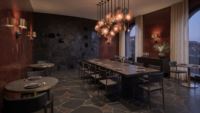
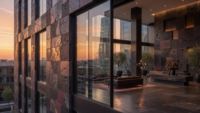
Two projects appear by name in Ranieri documentation. Twenty Old Bailey, an office and workshops scheme in London, dates to 2017 and was delivered as supply and fitting. Six Milano, a hospitality project in Milan, dates to 2023 and was also delivered as supply and fitting.

Alongside these, the colour customisation section of the published documentation cites the artist Olafur Eliasson, the Four Seasons Miami and Massimo Bottura’s Osteria Francescana among the projects developed with a commissioned colour.

The common thread is worth stating plainly, because it is the actual answer to the question of why lava appears in projects of this kind. In each case the material arrives with the work of specifying and fitting it attached, rather than as a consignment left at the edge of a site. An artist’s commission, a hotel, a restaurant and an office building are four different briefs; the procedure behind them is the same one.

Colour as a commission, not a selection

Colour customisation follows a documented sequence. A project starts from a base theme colour; the masters then develop a palette of natural gradients around it; and the colour that results is archived in that client’s colour library so it can be used again later. It applies to tiles and claddings, table tops, worktops, reception desks and furniture.

The archive behind this is substantial and organised in seven ranges: whites and neutrals, yellows and browns, reds and oranges, pinks and violets, greens, blues, and greys and blacks. Names such as Old White, Caffè Beige, Brown Sugar, Red Coral, Ultra Violet, Petrol Green, Bondi Blue and Deep Grey Degradé sit inside those ranges as developed, repeatable colours.

The standard glazed range works on the same logic at a smaller scale. Deep color, the widest family, publishes sixteen colours in a palette drawn by David Lopez and Francesco Meda, and shows a fine crackle reaction to the stone below. An archived colour is the opposite of a trend: it is a commitment that a surface specified this year can be matched on a later phase of the same building.

Where the material is declared, and where the figures stop

Ten surface families are published, across four base materials: Compact, Texture, Lunar and Pumice. Declared applications run across wall, floor, indoor, outdoor and swimming pool. Eight of the ten families are declared for swimming pool use; linear color and metallic stone are the two that are not.

Dimensions are equally explicit. Flat formats are produced at 10, 20 and 30 mm, in squares of 50 x 50 and 100 x 100 mm and bars of 300 x 25 and 600 x 40 mm. Three-dimensional profiles sit at 30 and 50 mm, and Onda at 800 x 150 x 30 mm. Blocks are cut at sizes up to three metres, which sets the limit for anything made in one piece. Products with textural surfaces carry a published dimensional tolerance of 3 to 8 mm.

Quantified performance figures are a separate matter, and it is more useful to say so than to imply otherwise. Compressive and flexural values, water absorption, slip resistance classes and UV data are established by finish and by format, and should be requested from the workshop for the specific specification rather than assumed from a general statement about volcanic stone.

Against the idea of a trend

What is actually spreading is a tolerance for variation. Craquelé, mineral micro-variation and difference between one slab and the next belong to the grammar of this material rather than to a list of things to be corrected, and a growing number of studios now specify on that basis instead of asking for uniformity and being disappointed.

One detail from the published documentation shows how far that goes. On stopped edges, hand-applied glazes accumulate and read darker; where a project does not want that effect, the documentation proposes rounded sections and edges instead. The variation is treated as a parameter with two available answers, rather than as a fault with one fix.

This is where Ranieri differs from a general account of volcanic stone. The variation is upstream, in the quarry and in the fire; what a project chooses is how much of it to keep. A studio that wants a surface without memory has easier materials available. A studio that wants the memory has to accept that the stone will keep some decisions for itself, and that is the actual reason this material has travelled as far as it has.

Why is lava stone being specified in international projects?

Because it now arrives as a specifiable material rather than a regional speciality: published formats and thicknesses, declared applications across wall, floor, indoor, outdoor and pool, and a documented colour procedure that can be repeated on later phases. Ranieri also delivers supply and fitting, so specification support travels with the stone.

Which Ranieri projects can be cited publicly?

Ranieri documentation names Twenty Old Bailey, an office and workshops scheme in London from 2017, and Six Milano, a hospitality project in Milan from 2023, both delivered as supply and fitting. The colour customisation section also cites Olafur Eliasson, the Four Seasons Miami and Osteria Francescana.

Is lava stone declared for outdoor and swimming pool use?

Declared applications cover wall, floor, indoor, outdoor and swimming pool. Eight of the ten published surface families are declared for swimming pool use. Linear color and metallic stone are the two families that are not. Frost, absorption and chemical resistance figures should be requested for the specific finish.

How does a project commission a colour outside the standard range?

The sequence starts from a base theme colour. The masters develop a palette of natural gradients around it, and the resulting colour is archived in that client’s colour library for later reuse. It can be applied to tiles, claddings, table tops, worktops, reception desks and furniture.

Where is Ranieri lava stone quarried and worked?

At Terzigno, at the foot of Vesuvius, from a family quarry, in a workshop in the same area. Extraction is described as low impact and the transformation as zero-waste, combining hand chiselling with modern cutting techniques. Origin and processing sit in the same place rather than in a supply chain.

Projects and commissions named in Ranieri documentation

Project

Type

How it appears in Ranieri documentation

Year and place

Twenty Old Bailey

Office and workshops

Delivered as supply and fitting

2017, London (UK)

Six Milano

Hospitality

Delivered as supply and fitting

2023, Milan (Italy)

Olafur Eliasson

Artist commission

Cited in the colour customisation section

Place and year not published

Four Seasons Miami

Hospitality

Cited in the colour customisation section

Miami (USA), year not published

Osteria Francescana

Restaurant

Cited in the colour customisation section

Modena (Italy), year not published