
2026.08.10

Is Stone Flooring Worth the Investment for Luxury Properties?

Table of contents

Is Stone Flooring Worth the Investment for Luxury Properties

The question is usually asked about the first day and answered about the tenth year. A stone floor is worth specifying when it is still the right floor after a decade of use, after a change of ownership, after the phase two nobody mentioned at the briefing, and after the section that had to be lifted for a service run. That makes the choice of the format and module a longer-term decision than it first appears.

For lava stone the honest answer has three parts, and only one of them is about hardness. The first is what the floor has to survive. The second is whether the same surface can be obtained again years later, which is where most natural stone specifications quietly fail. The third is how the material ages when it is finally left alone.

What follows works through those three, using the figures Ranieri publishes and stating where the published data ends.

What a floor actually has to survive

Ranieri documentation describes lava as harder and more resistant than marble. That statement sets a direction, and for a floor the useful detail sits underneath it, in the thickness bands and in the finish families.

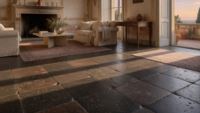
Flat formats are produced at 10, 20 and 30 mm, across squares of 50 x 50 and 100 x 100 mm and bars of 300 x 25 and 600 x 40 mm. Ten millimetres is the refurbishment thickness, going down over an existing floor where the finished level cannot move. Twenty and thirty millimetres give a floor that behaves as a floor, which is the sensible band where the build-up is being made from scratch and the room will be used properly.

Declared applications run across wall, floor, indoor, outdoor and swimming pool. Eight of the ten surface families are declared for swimming pool use, and the two exceptions are linear color and metallic stone. Those two exceptions carry real weight in a residence with a spa or a pool terrace, because they narrow the palette for the wet part of the plan before any aesthetic discussion starts.

Quantified figures are the part to request rather than assume. Abrasion resistance, slip resistance class, water absorption and frost resistance are established for the specific finish and format, and a floor specification should ask for them in that form.
Repeatability, and the argument nobody makes

Here is the part of the question that decides most stone floors, and it has nothing to do with performance. Five years after completion, a pipe fails under a corridor. A wing is reconfigured. A second building goes up on the same estate and has to read as part of the first. At that moment the only question that matters is whether the same surface can still be obtained.

For most natural stone the honest answer is a shrug: a different bed of the quarry, a different batch, a visible seam between old work and new. For a glazed lava surface developed at Ranieri, the answer is documented. Colour customisation starts from a base theme colour, the masters develop a palette of natural gradients around it, and the colour that results is archived in that client’s colour library so it can be produced again later.

That archive is organised in seven ranges and holds a large body of developed colours, from Old White and Cream Satin through Brown Sugar, Red Coral, Pink Sand, Forest Green, Bondi Blue and Deep Grey Degradé. A colour in that library is a specification that survives the people who wrote it. For a property that will be extended, refitted or sold, it is the strongest long-term argument the material has, and it is rarely the one that gets made.

Modules, and the arithmetic of replacement

Format choice looks aesthetic and behaves logistically. A floor built from 50 x 50 or 100 x 100 mm squares, or from 300 x 25 and 600 x 40 mm bars, can be opened and closed in small areas: a service run crosses a corridor, a limited number of modules come up, and the repair reads as part of the grid rather than as a patch.

The same logic runs through the three-dimensional range. The nine 3D bar profiles all share a 600 x 40 mm plan and differ only in profile and height, at 30 or 50 mm, so a vertical surface can be composed from several profiles and later repaired from any of them. Onda works at 800 x 150 x 30 mm, and the 3D flat profiles at 300 x 300 and 300 x 150 mm, all at 30 mm.

For work made in one piece the governing figure is different: blocks are cut at sizes up to three metres. That is what makes a monolithic basin, a bath or a single-piece island possible, and it is also the figure that tells you when a design has to become an assembly instead.

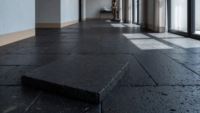
One published tolerance shapes all of this. Products with textural surfaces carry a dimensional tolerance of 3 to 8 mm, which rules out flush junctions with machined materials and asks for shadow gaps and recessed joints. Detailing that way from the start is what makes a later replacement possible without reopening half the room.

Ageing that is not deterioration

A uniform industrial floor has a difficult relationship with time, because uniformity is the standard against which every mark is read. The first scratch is visible precisely because everything around it is identical. A material that begins from variation behaves differently: craquelé in the glazed families, mineral difference between one piece and the next, the darker accumulation where hand-applied glaze meets a stopped edge.

Ranieri treats those as the grammar of the material rather than as tolerances to be tightened, and the documentation goes as far as proposing rounded sections and edges where a project does not want the darker accumulation on a stopped edge. Variation is offered as a parameter with two answers, not as a fault with one fix.

This is where the volcanic origin stops being narrative and starts being useful. The stone was already irregular when it was cut at Terzigno; the fire had done its work long before the specification existed. A floor made from it does not have a factory finish to fall away from. It has a condition it was already in, and use moves it slowly along a path it was on anyway.

So is it worth specifying

For a project that will be used, changed and extended, the case rests on three documented things rather than on the word durable: a thickness range that lets the floor be built properly at 20 or 30 mm, modules small enough that a repair stays local, and a colour archive that makes the same surface obtainable years later.

For a project that needs a flush, machined, dimensionally exact floor and will never be touched again, the textural families are the wrong starting point, and the 3 to 8 mm tolerance says so honestly before anyone gets to site. That is a better answer than a claim of universal suitability, and it is the one the published figures actually support.

FAQ

What determines how long a lava stone floor lasts?

Three published decisions: thickness, with 20 and 30 mm giving a floor built as a floor and 10 mm suiting refurbishment over a fixed level; the finish family, since declared applications differ; and detailing that respects the 3 to 8 mm tolerance on textural surfaces rather than fighting it.

Can the same lava stone colour be obtained years later?

Yes, when the colour has been developed through colour customisation. The process starts from a base theme colour, the masters develop a palette of natural gradients, and the resulting colour is archived in that client’s colour library, so a later phase or repair can be produced from the same reference.

Which lava stone finishes are unsuitable for wet areas?

Linear color and metallic stone are the two families not declared for swimming pool use; the other eight are. The metallic finishes also carry contact warnings: Gold should avoid acidic food and drink, and tea, coffee or wine can damage Bronze irreparably.

How is a damaged section of a lava stone floor repaired?

Module size decides this. Floors built from 50 x 50 or 100 x 100 mm squares, or 300 x 25 and 600 x 40 mm bars, can be opened and closed locally so a repair reads as part of the grid. An archived colour makes the replacement pieces match.

Does lava stone need a different detailing approach?

Textural surfaces publish a dimensional tolerance of 3 to 8 mm, so junctions with machined materials should use shadow gaps, recessed joints and deliberate reveals instead of flush meetings. Designing that way from the start also makes later replacement possible without disturbing the surrounding floor.

The colour archive, organised by range

Range in the Ranieri colour archive

Examples of developed colours held in the archive

Whites and neutrals

Pure White, Old White, Almond, Cream Satin, Vanilla, Caffè Beige, Cloud Cream, Sand, Linen, Argilla

Yellows and browns

Citron, Empire Yellow, Honey Yellow, Curry, Tiramisu, Caramel, Camel, Brown Sugar, Cinnamon, Chocolate

Reds and oranges

Shell Coral, Exotic Orange, Rust, Dark Copper, Red Wine, Warm Red, Watermelon, Red Coral, Brick Red

Pinks and violets

Cream Pink, Old Rose, Pink Sand, Candy Floss, Cherry, Magenta, Eggplant, Fig, Ultra Violet, Lavanda

Greens

Pistacchio, Lime Green, Oliva, Forest Green, Pine Green, Miami Green, Teal Green, Bottle Green, Emerald, Petrol Green

Blues

Rain, Duck Egg, Powder Blue, Denim, Ocean Blue, Crystal Seas, Sapphire, Blue Navy, Azure, Bondi Blue, Velvet Blue

Greys and blacks

Violet Pearl, Light Grey, Grigio Perla, Whale Grey, Concrete Grey, Caviar, Deep Grey, Graphite, Deep Grey Degradé, Total Black