Where the Stone Stays Visible: Bare Stone and Textural Surfaces
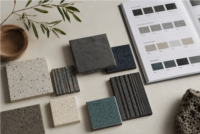
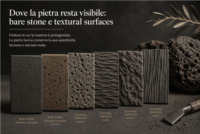
Bare stone leaves the mineral face as the finish. Three colours are published: Dark and Brown on Compact material, and Dark Moon on Pumice. Dark and Dark Moon are polished natural stone; Brown is fired polished natural stone, a firing pass applied to the bare face rather than a colour coat. Some types include natural open fissures and holes, while others can be worked to smooth, solid surfaces, which is a question to settle per piece rather than per family.
Textural surfaces sit on Texture material and are tooled rather than coloured: Crosta, Dune, Roccia and Linee are worked finishes, not pigments. Tooling here does two jobs. It adds character and grip, and it camouflages the natural open fissures that bare stone leaves exposed. Where a project wants raw volcanic reading without visible voids, textural surfaces are usually the more workable answer.
One specification note applies across this group: textural surfaces carry a published dimensional tolerance of 3 to 8 mm. Junctions should be detailed with shadow gaps or expressed joints rather than flush abutments.
Colour That Lets the Geology
Through
Three families apply colour while keeping
the stone readable beneath it, and each does so on a different base material.
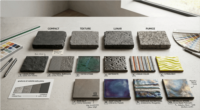
Tinted stone is the most direct: a colored
crystal on natural stone, described as a veil through which grain and mineral
flecks stay visible. On lighter tints, small spots appear where the minerality
comes through, and slight surface undulation can occur. Four colours are
published, on Compact material.
Meteorite works on Lunar material, whose
small craters and cavities are the point of the finish. Glaze settles into the
natural holes and outlines them, so the surface never repeats. Six colours are
published, some as tinted crystal on natural stone and some as colored crystal
on enamel, and pieces fired twice over a white glaze foundation show different
effects within the pits.
Linear color sits on Texture material,
where striations have been tooled into the surface before glazing. Colour then
pools in the fissures and thins across the ridges, producing deep accumulations
and transparent reliefs within a single piece, with a coarse, strongly haptic
edge. Four colours are published. This family is declared for wall, floor,
indoor and outdoor use, without swimming pools.
When Colour Takes Over: Citrus
Zest, Non-Slip and Deep Color
Citrus zest covers the stone entirely with
full-bodied enamel on a coloured engobe ground, yet the geology still asserts
itself through undulation and movement rather than through visible mineral.
Occasional green or darker splashes appear where minerals exit the interior.
Four colours, on Compact.
Non-slip is the matte counterpart, built as
a colored matte crystal on coloured engobe. Layer upon layer of opaque glaze
mutes the palette to pastels, and the added surface diversity increases slip
resistance. Terra, Havana, Concrete and Rattan are the published colours. For
wet circulation, pool surrounds and any floor where barefoot traffic is
expected, this is the family to look at first.
Deep color is the widest range at sixteen
colours, developed as a palette by David Lopez and Francesco Meda. It is a
colored crystal on enamel with an opalized finish and a deliberate fine crackle
against the stone below. Slight undulation and tonal variation are expected
characteristics. Where a stopped edge is used, glaze gathers and fires darker
at the arris; rounded edges and profiled sections are the documented
alternative.